
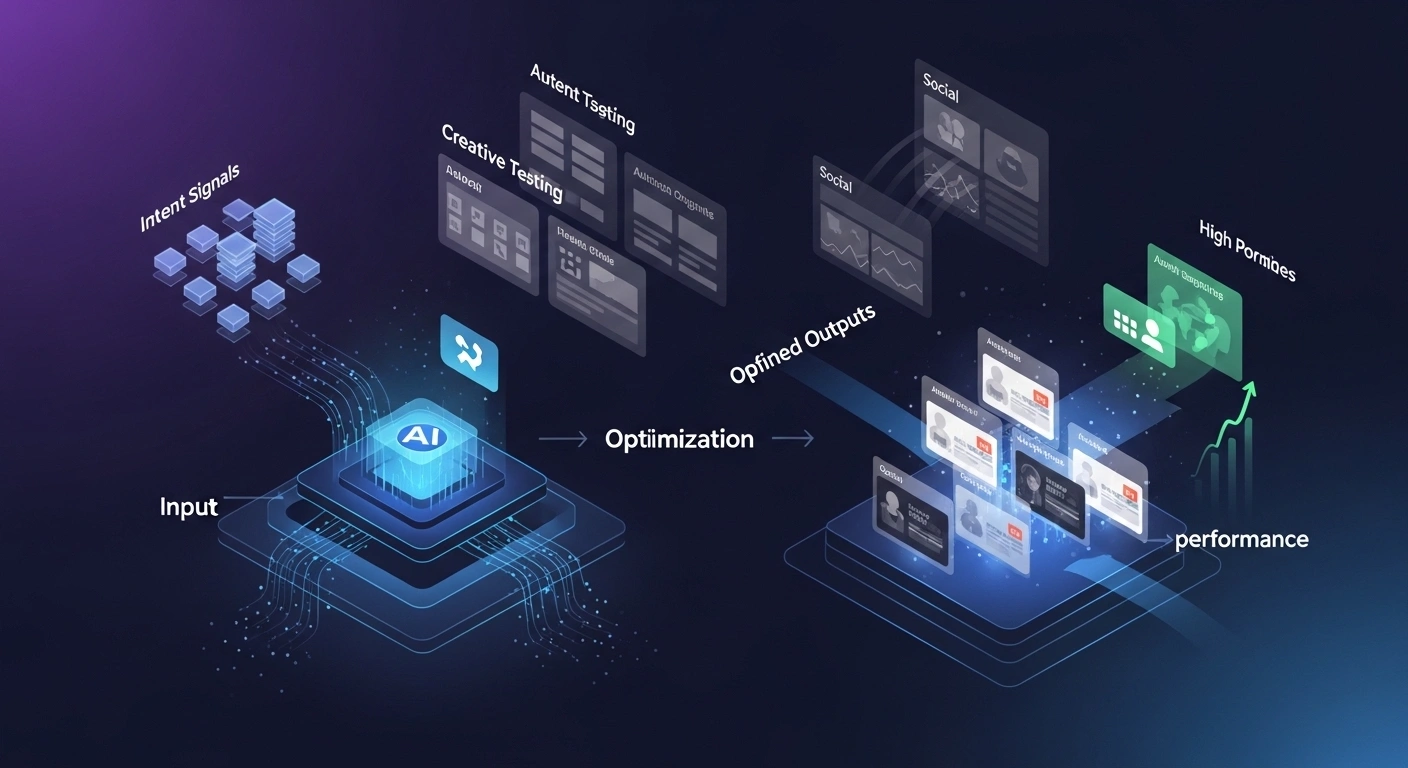
AI performance marketing is the application of artificial intelligence to plan, execute, and continuously optimise paid advertising campaigns across Google, Meta, and other digital platforms — with the goal of improving results while reducing wasted spend.
Most businesses run paid ads in a reactive way: they set up a campaign, wait a week or two, look at the results, make a few manual changes, and repeat. This slow feedback loop means you are always behind — optimising based on yesterday's data while paying for today's performance.
AI changes this by making optimisation decisions in real time, based on live data, testing hundreds of variables simultaneously — things no human ad manager can do manually.
When people hear 'AI performance marketing,' they often imagine a complicated black box. In reality, AI does several specific, well-defined things:
AI monitors which ad sets, audiences, and placements are delivering the best cost-per-result at any given moment. It automatically shifts budget away from underperforming areas and toward what is working — sometimes making dozens of micro-adjustments in a single day.
A human ad manager doing this manually might review and adjust once or twice a week. AI does it continuously, meaning you capture more value from every rupee of ad spend.
Writing multiple versions of ad copy and creating multiple creative variations manually is time-consuming. AI can generate, test, and evaluate multiple ad variations simultaneously.
More importantly, AI can identify patterns in which creative elements drive performance — is it the headline format? The image style? The call to action? — and apply those learnings automatically to future creative decisions.
Traditional audience targeting relies on demographic and interest data that you define manually. AI targeting looks at behavioural signals — what content people have consumed, what they have purchased, how they interact with similar brands — and identifies audience segments that are statistically most likely to convert for your specific offer.
AI can also analyse which combinations of ad message and landing page content deliver the highest conversion rates, and automatically route traffic to the best-performing landing page variants.
Before diving into how to implement AI performance marketing, it is worth being honest about what manual ad management typically delivers:
None of this is a criticism of skilled human ad managers — it is simply the reality of what manual processes can and cannot do at the speed that modern digital advertising requires.
Google has been integrating AI into its ads platform for several years, and by 2026, AI is central to how the platform works. Performance Max campaigns, smart bidding strategies, and responsive search ads all use Google's own AI to optimise delivery.
The key to making Google's AI work for you is feeding it the right signals:
Many businesses underperform on Google Ads not because the platform does not work, but because they have not given Google's AI the data and assets it needs to optimise effectively.
Meta's advertising AI has become significantly more powerful since the introduction of Advantage+ campaigns. These campaigns use AI to identify your best-converting audiences dynamically, rather than relying on manual audience definitions.
For most businesses, the shift to Advantage+ has delivered:
The caveat is that AI-driven Meta campaigns require high-quality creative. The platform's AI cannot fix a weak ad — it can only distribute a strong ad more efficiently.
Most ad agencies run your campaigns manually, review them weekly, and charge you for the time they spend doing so. MautoAI takes a systems-based approach.
We build an AI-powered campaign management system that monitors your campaigns continuously, tests creative variations automatically, reallocates budget based on live performance data, and provides you with a clear monthly report showing exactly what the AI optimised and why.
The result is campaigns that improve every week — not just when someone has time to review them.
If you are currently running Google or Meta ads and want to know exactly where your budget is being wasted, MautoAI offers a free ad performance audit. Get a free ad performance audit at mautoai.in and we will analyse your current campaigns and show you the biggest opportunities for AI-driven improvement.
Learn more about our AI performance marketing service. Better yet, discover how to combine performance marketing with marketing automation, and understand why AI SEO complements paid advertising.
MautoAI is an AI automation and AI SEO agency based in Pune, India. We use AI to help businesses get better returns from their marketing spend. Learn more at mautoai.in.