
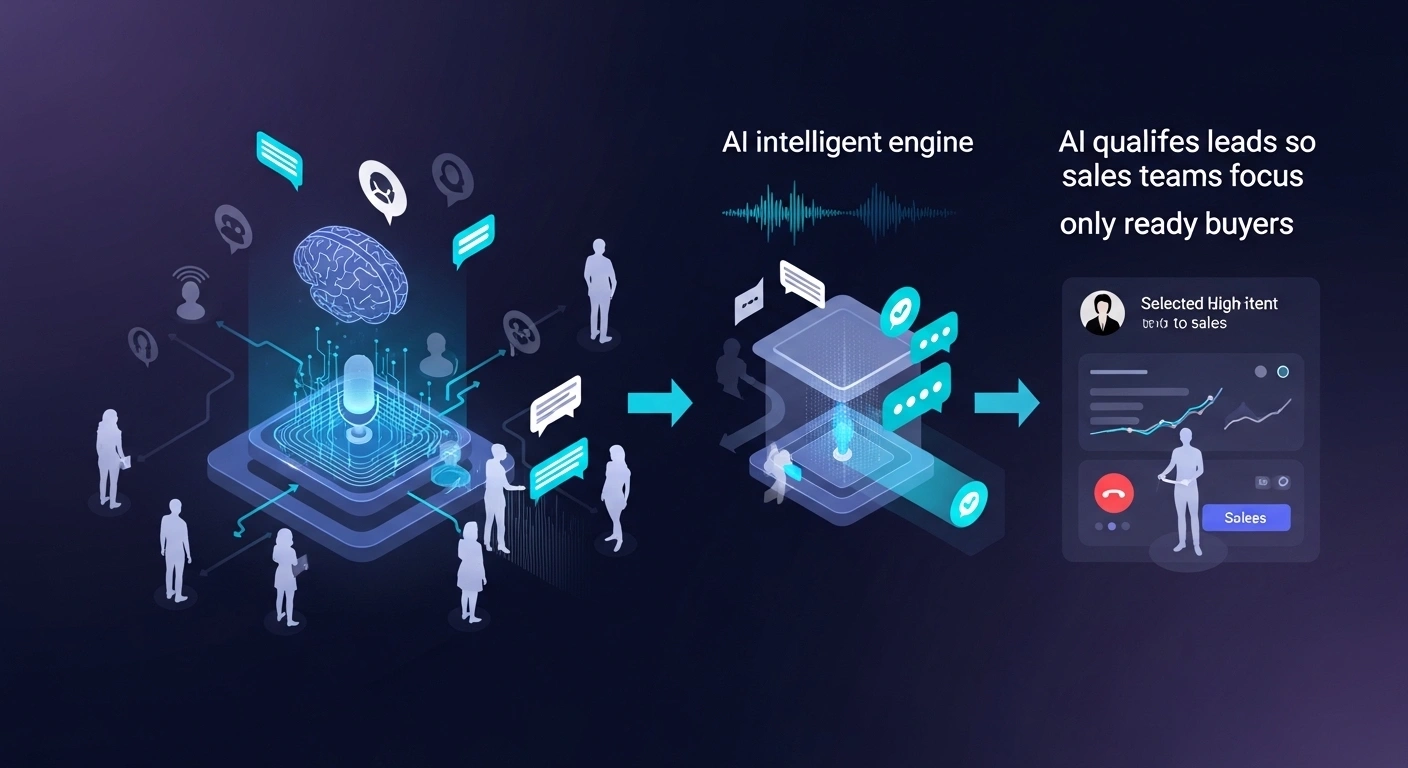
AI lead qualification is the process of using artificial intelligence — typically voice agents, chatbots, or automated scoring systems — to automatically evaluate incoming leads, determine how likely they are to convert, and route only the highest-quality prospects to your sales team.
Here is the problem this solves in plain terms: most sales teams spend the majority of their time talking to people who are not ready to buy, cannot afford the service, or were never a good fit in the first place.
Research consistently shows that sales representatives spend less than 40% of their time on actual selling. The rest goes on qualification, admin, and follow-up — all of which AI can handle faster and more accurately.
Traditional lead qualification has three major failure points:
The result of these failures is a sales team that is overworked but underperforming — spending most of their energy on leads that will never convert.
An AI voice agent is an automated phone system that sounds natural, conversational, and intelligent. When a new lead calls your business or submits a form requesting a callback, the AI voice agent calls them back within seconds.
The voice agent asks a structured set of qualification questions — things like budget, timeline, specific problem, and decision-making authority. Based on the answers, it either routes the lead to a human sales rep immediately or schedules them for a follow-up call.
The key difference from old-style IVR phone systems is that AI voice agents have a real conversation. They respond to what the lead says, handle objections, and adapt their questions based on the answers they receive.
A qualification chatbot engages visitors on your website or contacts on WhatsApp and guides them through a conversation that determines their fit and intent.
A well-designed chatbot asks three to five focused questions, provides helpful responses based on the answers, and either books a meeting for qualified leads or provides resources for leads who are not yet ready.
The advantage over a form is that chatbots feel like a conversation, not a survey. Completion rates for chatbot qualification flows are significantly higher than for static forms.
Lead scoring uses AI to analyse behavioural signals — which pages a lead visited, how many times they came back to your website, whether they opened your emails, which content they downloaded — and assigns each lead a score that predicts their likelihood to convert.
High-scoring leads go directly to your sales team. Low-scoring leads go into a nurturing sequence. Medium-scoring leads get targeted content designed to move them toward a buying decision.
The exact questions depend on your business and ideal customer profile. However, most effective qualification systems evaluate some version of the classic BANT framework:
Leads who score well on all four criteria are genuinely sales-ready. Leads who score low on one or more go into the appropriate follow-up track.
Consider a B2B service business that receives 200 enquiries per month. Without AI qualification:
With AI qualification:
The sales team does the same amount of work — but closes significantly more deals because every conversation they have is with a genuine prospect.
AI lead qualification is not a nice-to-have for growing businesses — it is quickly becoming a competitive necessity. Businesses that respond to leads in minutes instead of hours, and that route only genuine prospects to their sales team, will consistently outperform competitors running on manual qualification.
The technology is accessible, the setup time is measured in weeks rather than months, and the return on investment is typically visible within the first month of deployment.
MautoAI builds AI voice agents and chatbot qualification systems for businesses across India and globally. Request a free lead qualification demo to see exactly how AI qualification would work for your specific business at mautoai.in
Learn more about our AI lead qualification service. You can also explore how marketing automation connects with lead qualification, or see how AI reduced unqualified leads by 70%.
MautoAI is an AI automation and AI SEO agency based in Pune, India. We build intelligent systems that help businesses qualify leads, automate marketing, and rank on AI platforms. Learn more at mautoai.in.