
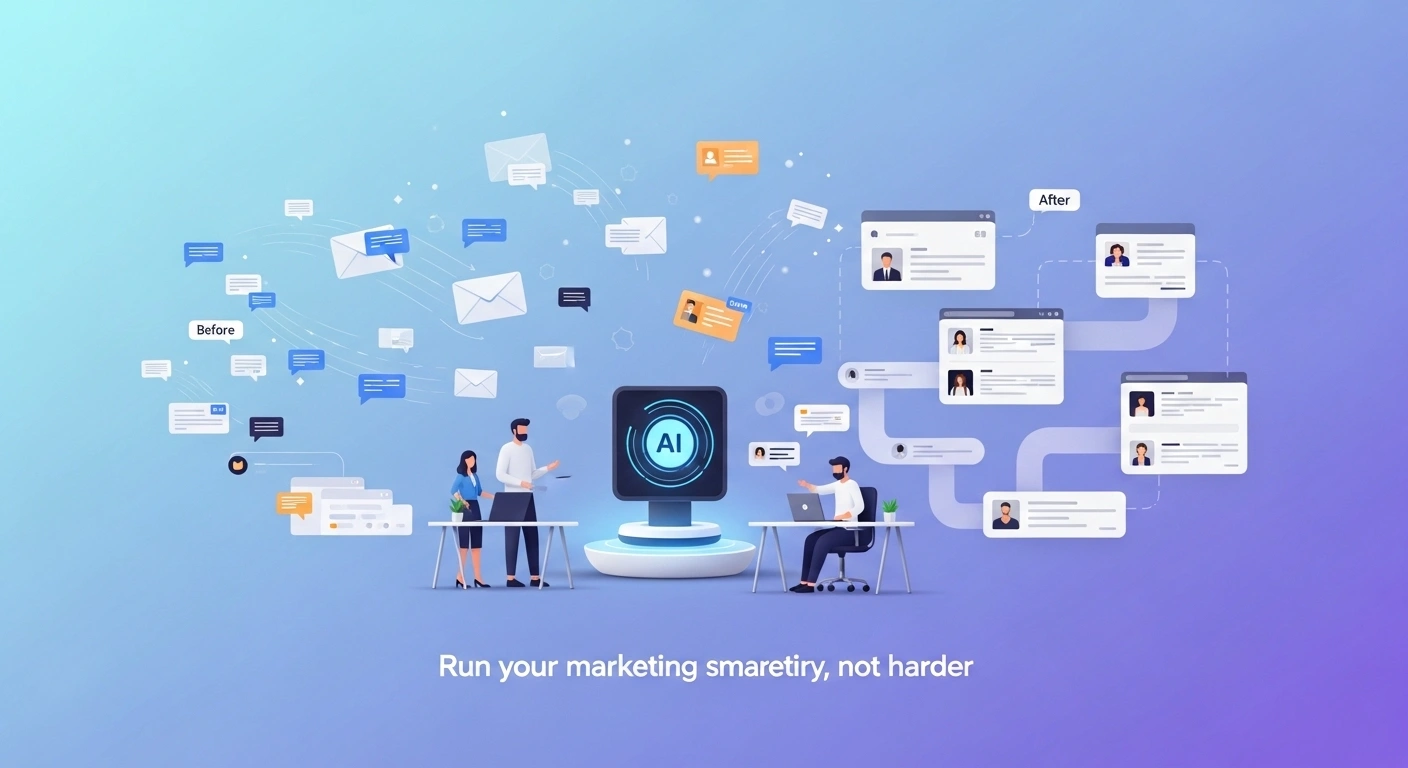
Marketing automation is the use of software and AI to automatically execute, manage, and optimise marketing tasks — such as sending emails, following up with leads, posting on social media, and running ad campaigns — without manual effort for each action.
Think about what happens when a new lead fills out a form on your website right now. Does someone manually send them a welcome email? Does your team remember to follow up in 48 hours? Does anyone send a second follow-up if the first one goes unanswered?
For most small businesses, the honest answer is: sometimes, but not consistently.
Marketing automation fixes this permanently. Once you set it up, every lead gets the right message at the right time — automatically, every single time.
Large companies have marketing teams. Small businesses do not. That is exactly why automation matters more for smaller businesses — it gives you the output of a full marketing team without the headcount cost.
Here is what automation enables a small business to do:
When someone fills out your contact form or signs up for your newsletter, what happens next is critical. Most businesses either send one generic email or nothing at all.
A proper welcome sequence looks like this:
This sequence can be set up once and runs automatically for every new lead forever. No manual work after the initial setup.
Every business has a database of leads that went cold — people who showed interest but never converted. Most businesses ignore them. Automation makes it easy to re-engage them at scale.
A simple re-engagement workflow: if a contact has not opened any email in 60 days, automatically trigger a short 3-email re-engagement sequence with a fresh angle, a useful resource, and a simple question like 'Is this still a priority for you?'
In India especially, WhatsApp has much higher open and response rates than email. A WhatsApp automation workflow can send a personalised follow-up message to new leads within minutes of them filling out a form.
Keep WhatsApp messages short and conversational. They should feel like a message from a real person, not a marketing blast.
After delivering a service or completing a project, automatically send a follow-up sequence that asks for feedback, provides useful resources, and gently introduces your other services. This is how you turn one-time clients into long-term relationships without manual effort.
Set up email triggers based on specific user actions: if someone visits your pricing page 3 times without booking a call, trigger an email offering a free consultation. If someone downloads a resource, trigger a follow-up email with a related resource.
Automatically update your CRM when a lead takes specific actions — visiting a page, opening an email, clicking a link. This means your sales team always has current, accurate data without manual data entry.
Basic automation follows fixed rules: if this, then that. A user fills in a form, they get an email. It is useful but limited.
AI-powered automation goes further. It can:
This is the difference between a decent marketing system and one that genuinely feels personal at scale.
Marketing automation is not about replacing human relationships — it is about making sure no opportunity falls through the cracks. For small businesses competing with larger companies, automation is the great equaliser.
The businesses that set up smart, well-crafted automation workflows today are the ones that will convert more leads, retain more clients, and grow faster — with the same team size.
Not sure where to start with automating your marketing? MautoAI offers a free 20-minute consultation where we map your current workflow and show you the 3 highest-impact automations for your specific business. Book a free marketing automation consultation at mautoai.in
Learn more about our marketing automation service. You can also explore how AI qualifies leads automatically, or read about how AI SEO complements your automated marketing efforts.
MautoAI is an AI automation agency based in Pune, India, helping businesses automate marketing, qualify leads, and grow efficiently with AI. Learn more at mautoai.in.