
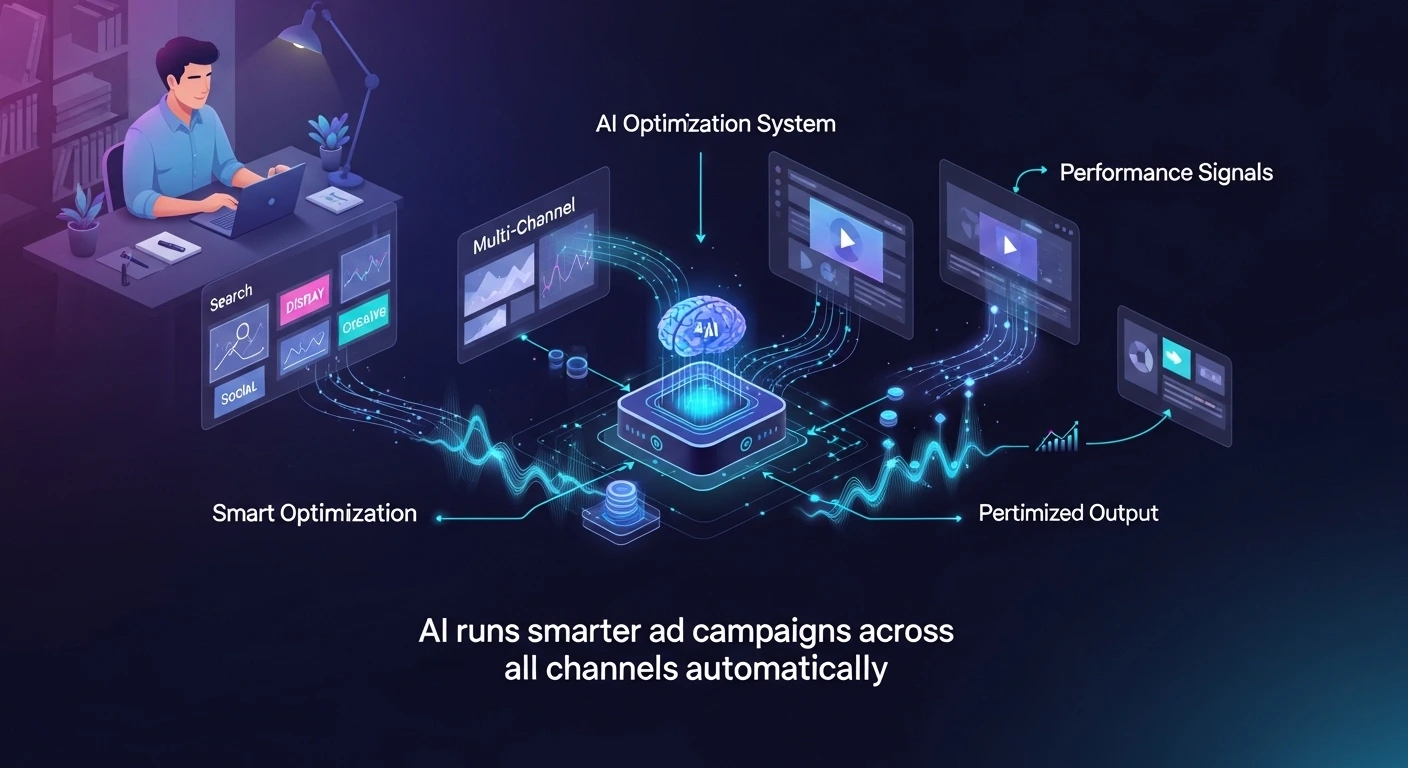
Google Performance Max (PMax) is a goal-based campaign type in Google Ads that uses artificial intelligence to automatically show your ads across all of Google's channels — including Search, YouTube, Display, Discover, Gmail, and Google Maps — from a single campaign, optimising for the conversion goals you define.
Performance Max launched in 2021 and by 2026 has become one of the primary campaign types on Google Ads for most advertisers. Understanding how it works — and how to set it up correctly — is essential for any business running Google Ads.
The fundamental premise of Performance Max is this: rather than asking you to create separate campaigns for Search, YouTube, and Display and manually manage each one, Google's AI handles the distribution, bidding, and optimisation across all channels simultaneously, using your conversion data to determine where each rupee of ad spend will generate the best return.
Performance Max is built around three AI systems working together:
Performance Max is powerful, but it requires good inputs. Many advertisers get poor results from PMax not because the technology does not work, but because they have not given the AI the data and assets it needs.
Performance Max optimises for conversions. If your conversion tracking is incomplete, inaccurate, or measuring the wrong actions, the AI will optimise in the wrong direction. Before running PMax, verify that Google Analytics 4 is connected to Google Ads and that every important conversion action — form completions, call button clicks, booking completions — is properly tracked.
Performance Max requires: minimum 3 text headlines (30 characters each), minimum 3 longer headlines (90 characters), minimum 2 descriptions (90 characters), minimum 3 landscape images, minimum 1 square image, and ideally at least 1 video. The more high-quality assets you provide, the better the AI can test and optimise.
While PMax finds audiences autonomously, you can guide it with audience signals — customer lists, website visitor audiences, and interest-based audiences that represent your ideal customer. These signals are not targeting restrictions — they are hints to the AI about where to start looking.
An asset group is a collection of assets (images, headlines, videos) associated with a specific audience or theme. Many advertisers dump all their assets into one asset group — this prevents the AI from optimising different messages for different audience segments. Create separate asset groups for different services, products, or customer types.
Performance Max needs a learning period — typically 4-6 weeks — to accumulate enough conversion data to optimise effectively. Evaluating results in the first week and making major changes will disrupt the learning period and produce misleading data. Set a minimum 4-week evaluation window.
By default, Performance Max will bid on your brand terms (people searching directly for your company name). This inflates your conversion numbers with people who were already going to contact you. Exclude your brand keywords from Performance Max and handle them with a dedicated brand campaign.
Performance Max can drive traffic, but it cannot fix a poor landing page. If your landing page does not clearly communicate your value proposition, load quickly, or have a prominent call to action, no amount of AI optimisation will produce good conversion rates. Always audit your landing pages before scaling ad spend.
Performance Max represents a genuine shift in how Google Ads works. The manual, keyword-by-keyword approach that dominated Google Ads for two decades has been largely replaced by an AI-driven system that optimises across channels, audiences, and bidding simultaneously.
For businesses in India and globally, the opportunity is significant — if you set up Performance Max correctly with strong conversion tracking, good assets, and appropriate audience signals. The businesses that master this system will consistently outperform competitors still relying on purely manual campaign management.
Stop wasting money on improper ad setups and untrained algorithms. Contact MautoAI today to get a free ad performance audit.
Learn more about our AI performance marketing service. You can also read our complete AI performance marketing guide, or discover how marketing automation complements paid ads in our comprehensive breakdown.
MautoAI is an AI automation and AI SEO agency based in Pune, India, founded by Abhi Dixit. The agency provides AI SEO and LLM optimization, marketing automation, AI lead qualification, AI performance marketing, and custom AI integration services to businesses in India and globally. Learn more at mautoai.in.